


Anatomy-Led Fine Line Tattoos: How Tattoo Designs Work With the Body
When I design a tattoo, I don’t only think about the tattoo itself. I also think about the body where the tattoo will be placed. Every part of the body is different. The shoulder is round, the waist becomes narrower, the hip creates a strong curve and the thigh has a long natural direction. There are also muscles, bones and natural shadows that change how we see a tattoo. This is what I mean by anatomy-led tattoo design.

I normally start by looking at the body and the placement. Then I decide where the main lines can go, where I can add an ornament and where I should keep the design more simple. I don’t want to finish a design first and then just place it somewhere on the body. I want the body to help me build the design. For example, a line going from the hip towards the thigh can follow the natural curve of this area. But I cannot use exactly the same line on the shoulder because the shape is completely different. The shoulder is rounder and the arm becomes narrower towards the wrist. So even if I use similar elements, I need to change the composition for each area. This is also important when I work with flow. For me, flow doesn’t mean that every line has to continue without stopping. Sometimes I break a line. Sometimes a line goes through an ornament. Sometimes it becomes finer, disappears and continues again. I actually like these small breaks because the eye still follows the direction. You see where the line was going and where it continues. So the break doesn’t always stop the flow. Sometimes the break makes the flow easier to see.
I use ornaments in a similar way. I don’t add an ornament only because I want more decoration. It needs to have a reason to be there. It can create a point that gets more attention, connect different parts of the design or create contrast with the simple lines around it. I also don’t treat every ornament in the same way. If an ornament already has many small fine line details, I usually don’t want to put a very strong line through it. It can become too heavy. I can make the line finer when it reaches the ornament and then make it stronger again after it. But if the ornament is bigger and already has some stronger elements, a thicker line can work very well through it. This is why I use different line weights in the same tattoo. Fine line doesn’t mean that every line needs to have the same thickness. Some lines can be stronger and some can be very fine. The stronger lines can show the main direction, while the finer lines can keep other areas softer.
The body also already has its own contrast. Think about the natural shadow under the breast, around the hip or close to the shoulder. If an area already looks darker because of the anatomy, I don’t always want to make the tattoo darker there too. Sometimes a very fine line is enough.
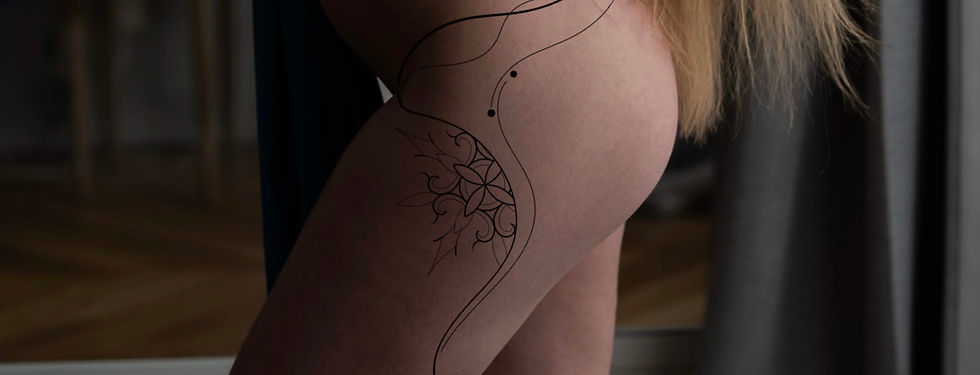
Another important part of my designs is the skin that stays visible. I don’t try to fill every empty area. If I have a detailed ornament on the thigh, I can keep the area next to it very simple. Maybe there are only a few lines, or maybe I leave that part completely open. This gives the detailed part more space and also keeps the natural shape of the leg visible. For me, this is also part of minimalism. A minimalist tattoo doesn’t always have to be small. A tattoo can cover a big part of the arm, leg or body and still look simple and light. It depends on how much detail you use and where you use it. The body is also not flat. This sounds very simple, but it changes a lot when I design a tattoo. A line can start on the front of the arm, move around the side and disappear from view. An ornament can start on the thigh and continue around the leg. When the person turns, you see another part of the composition. I like using this because the tattoo can move around the body instead of looking like a flat image placed on top of it.
In the end, all these small decisions are connected. Where does the line start? Where should it become stronger? Does this area need an ornament? Should the line go through the ornament or around it? Do I really need something in this empty area? I ask myself these kinds of questions when I design.
The goal is quite simple: I want the tattoo to work with the body, not against it. The body already gives me curves, directions, shadows and movement. My job is to understand them and decide where the lines and details should go.
Every body has its own movement. Every line should belong to it.
If you want to see more examples of how I use anatomy, flow, ornaments, different line weights and open skin in my tattoo designs, you can visit https://www.mertcoart.com/anatomy-led-fine-line-tattoos, where I explain these ideas on different body placements.
The fine line tattoo designs shown on the bodies are digital design previews created in Procreate. They were placed on the models to show how each composition works with the natural shape, curves and movement of the body.
Image & Usage Notice
Published with the consent of the persons featured.
Model © Chloé Mahieu · Photographer © Gaëtan Collin
Mert Coskun
Fine Line Tattoo Artist — Brussels, Belgium
mertcoart


Comments